How AI Telematics and Edge Intelligence Optimize Fleet Operations
The transport and logistics sector is changing at a breakneck pace. Fuel costs keep rising, supply chain volatility persists,and delivery deadlines are tighter than ever. Relying solely on basic GPS tracking to monitor vehicle coordinates is no longer enough to stay competitive in this environment. Simply knowing latitude and longitude gives fleet managers no warning about driver fatigue, impending engine component failures, or wasteful routing habits.
To move beyond basic location monitoring, transport companies are adopting AI telematics as the next evolutionary step in fleet management. Combining artificial intelligence with real-time telemetry shifts fleet operations from reacting after a breakdown occurs to preventing issues before they impact the business. This proactive model improves driver safety,optimizes resource efficiency, and protects operational margins.
Key Takeaways
- Beyond GPS tracking. AI telematics shifts fleet operations from simple vehicle tracking to proactive, automated decision-making, delivering substantial gains in fuel economy, road safety, and predictive maintenance.
- The power of Edge AI. Running data calculations directly on tracking hardware removes latency, lowers cellular data costs, and enables instant, real-time responses to critical highway events.
- Simplified customization. Development tools like Ruptela’s Virtual Engineer make edge computing and custom device logic accessible without needing specialized programming teams.
What is AI Telematics and Why Does It Matter?
At its core, AI telematics integrates machine learning algorithms, edge computing, and predictive data processing with standard vehicle telematics hardware. Traditional systems collect raw vehicle metrics and upload them to a central server, leaving fleet managers to manually analyze charts and reports. In contrast, applying artificial intelligence to telemetry lets systems actively analyze patterns, flag hidden risks, and automate daily tasks.
| Traditional telematics | AI-powered telematics |
|---|---|
| Logs location coordinates and trip history | Predicts component failure before a breakdown occurs |
| Records speeding after an infraction happens | Delivers real-time in-cab coaching and risk alerts |
| Transmits high volumes of raw data via cellular networks | Filters data locally on the device to cut cellular transfer costs |
| Relies on manual, reactive problem-solving | Triggers automated, event-driven workflows |
The rapid adoption of AI in telematics industry addresses three major operational pain points facing fleet operators today:
- Surging fuel costs. AI flags subtle inefficiencies in driving style and engine idling that static reports miss.
- Unplanned downtime. Predictive models analyze mechanical wear patterns to schedule servicing before a vehicle breaks down on the road.
- Driver safety & liability. Machine learning identifies risky driving behaviour and fatigue before they lead to costly collisions.
To learn more about how tracking hardware collects raw vehicle metrics, explore how telematics works or review strategies for controlling overall fleet management costs.
Core Use Cases of AI in Modern Fleet Management
The practical value of AI in telematics spans every operational layer of transport logistics. Converting continuous telemetry streams into actionable intelligence protects asset lifespans, improves driver safety, and sharpens daily routing across commercial fleets. By embedding machine learning models directly into daily workflows, transport operators gain granular visibility into both vehicle performance and driver habits. This multi-layered approach ensures that data collected from sensors translates into measurable financial savings and higher operational reliability.
Predictive maintenance and asset longevity
Unexpected mechanical breakdowns disrupt delivery schedules, destroy customer trust, and drastically increase emergency repair costs. Traditional fleet maintenance relies on rigid, fixed mileage schedules or reactive fixes executed only after a check-engine warning light appears on the dashboard.
AI algorithms evaluate live CAN bus telemetry, including engine coolant temperatures, oil pressure fluctuations, RPM spikes, turbocharger boost levels, and fuel flow rates, to spot early signs of mechanical degradation. Machine learning models compare current sensor values against historical baseline performance curves to detect subtle anomalies that human inspectors would miss.
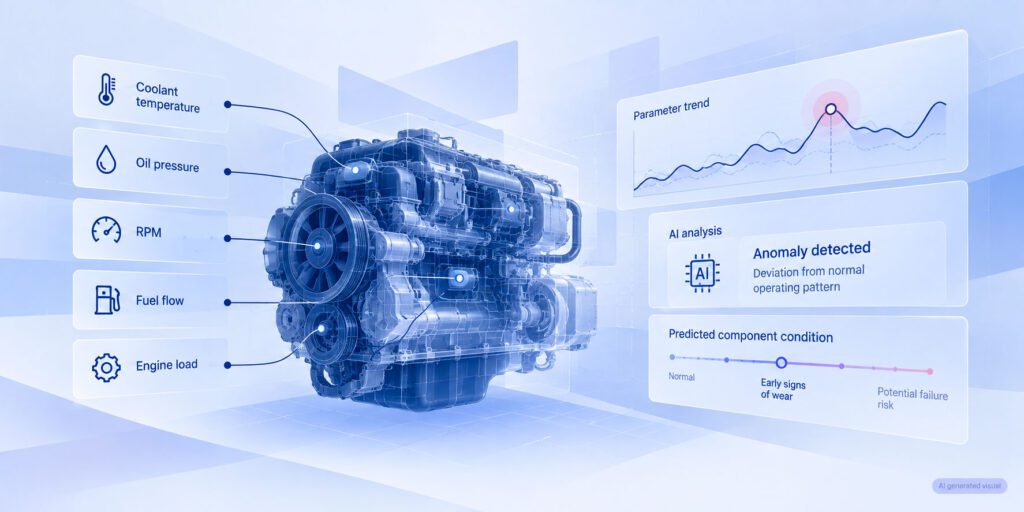
Identifying thermal spikes or gradual pressure drops long before a check-engine light illuminates lets fleet managers shift from expensive emergency roadside repairs to planned, cost-efficient shop servicing. Scheduling maintenance around quiet operational windows extends overall asset lifespans, minimizes shop downtime, and keeps heavy-duty trucks earning revenue on the highway.
Eco-driving and behaviour analysis
Driving style directly impacts fuel burn, tire degradation, brake wear, and collision risks. AI models process continuous telemetry streams to evaluate driver behaviour objectively and continuously, spotting harsh acceleration, abrupt braking, sharp cornering, and prolonged engine idling periods.
Instead of flooding managers with hundreds of raw event logs at month-end, AI platforms automatically categorize and score driver safety levels based on risk severity. The system can trigger automated, personalized coaching modules or deliver instant audio warnings inside the vehicle cab to correct unsafe habits immediately. Over time, cultivating an eco-driving culture slashes fuel consumption, lowers vehicle maintenance overhead, reduces wear-and-tear on tires and brakes, and cuts insurance premiums across the entire fleet.
Smart route and fuel optimization
Static route planning struggles to adapt to unpredictable highway conditions, roadwork closures, and changing weather patterns. Platforms leveraging AI in the telematics industry evaluate live traffic congestion, historical transit delays, weather forecasts, and vehicle payload weights to dynamically calculate optimal travel paths.
When unexpected traffic bottlenecks or severe weather arise, the AI system recalculates alternative routes automatically. This proactive re-routing reduces unproductive idling in traffic jams, lowers carbon emissions, saves fuel, and keeps delivery ETAs accurate for end customers. Furthermore, route optimization models balance driver workload schedules to comply with statutory driving hours regulations while maximizing vehicle productivity.
The Power of Edge AI: Processing Data Directly on the Hardware
Standard telematics devices act as simple data pipes, pushing all raw metrics to the cloud for processing. As vehicles add more sensors, sending every single data point over cellular networks increases latency and drives up mobile data bills. The industry is moving toward Edge AI, running machine learning models and processing calculations directly on the physical tracking hardware installed inside the vehicle.
Key operational benefits of Edge AI include:
- Zero-latency response. Critical safety events like severe collisions, rollovers, or geofence breaches trigger local hardware actions instantly without waiting for a cloud server signal.
- Reliable security monitoring. Edge devices evaluate security rules locally, keeping anti-theft protocols active even when traveling through areas with zero cellular reception.
- Lower cellular data expenses. The tracker filters sensor noise locally and sends only key summaries, exception reports, and alerts to the cloud server, significantly cutting monthly SIM card data expenses.
Smarter Edge Logic: Ruptela AI Scripting & Virtual Engineer
Setting up custom edge logic on tracking devices used to require specialized software engineers and long firmware build cycles. Ruptela removes this barrier with its Scripting Solution, which allows custom rules to run natively on professional GPS trackers like the HCV5 Lite, Pro5 Lite, and Smart5.
At the center of this ecosystem is Virtual Engineer, Ruptela’s AI-powered scripting assistant. Fleet managers and engineers no longer need programming experience to build custom device behaviours. You can describe the device behaviour you need in plain, natural language, and Virtual Engineer translates those instructions into executable Lua scripts that run directly on the tracker.
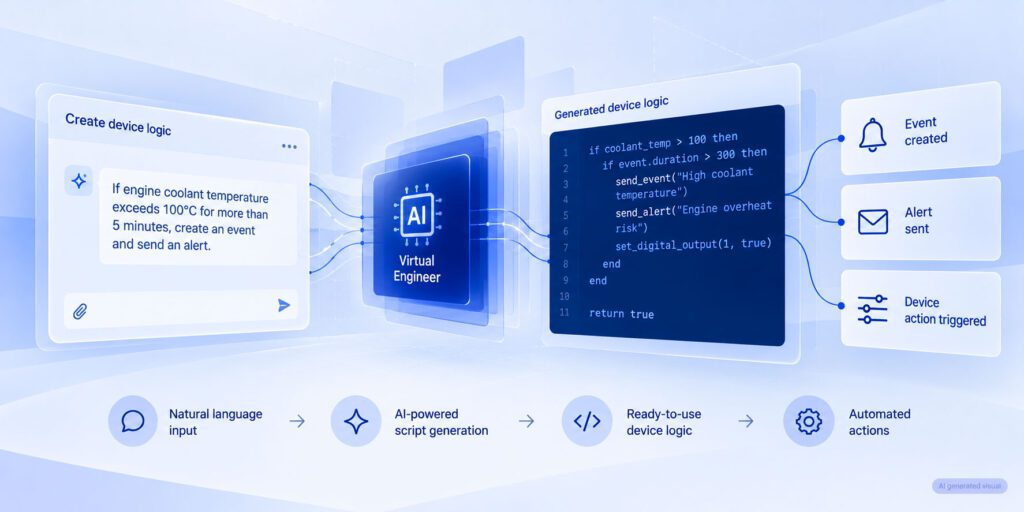
For example, you can prompt Virtual Engineer to build custom device behaviours such as:
- “If digital input 1 stays active for more than 5 minutes while vehicle speed is 0 and engine RPM exceeds 1000, sound the buzzer and send an alert.”
- “If cargo temperature goes above 4°C during weekend hours inside a specific geofence, activate the auxiliary cooling relay right away.”
Combining artificial intelligence with flexible hardware scripting lets transport companies deploy custom edge logic in minutes rather than waiting months for custom firmware development.
Steer Your Fleet into the Future with Ruptela
The future of logistics belongs to businesses that combine reliable hardware with flexible, intelligent software. As AI telematics continues to redefine commercial transport, having adaptable tracking hardware gives fleet operators a clear competitive advantage.
With almost two decades of industry experience and clients across 150+ countries, Ruptela delivers high-quality GPS hardware and practical software tools to help modernize your operations. Explore Ruptela’s range of professional GPS tracking devices, try out the AI-powered Scripting Solution, or contact the Ruptela sales team to schedule a custom demo for your business.