Key Pillars of a Successful Fleet Safety Program
A driver starts their shift at 5 a.m., already tired, with twelve stops ahead and a schedule that leaves little room for delays. Somewhere else in the fleet, a truck heads out with a tire that should have been replaced last week. Most days, nothing happens. But one bad day can cost far more than any repair bill. That’s why fleet safety today means more than having good insurance. It means spotting risks early and addressing them before they become incidents, and telematics gives you the data to do exactly that.
Why Fleet Safety Should Be Your Top Priority
When a fleet vehicle is involved in an accident, repairs are usually the smallest part of the bill. You may also face medical costs and damaged cargo, and after the claim, insurance premiums tend to rise. While the vehicle sits in the workshop, it isn’t earning anything, and someone still has to cover its deliveries. In more serious cases, legal questions arise, investigations begin, and customers start to wonder whether they chose the right partner.
So fleet vehicle safety pays for itself. Fewer accidents mean lower insurance and repair costs, less downtime, and a more predictable business. If you’d like a closer look at where the money goes, our article on fleet management costs breaks it down.
The Key Pillars of a Modern Fleet Safety Program
There’s no single fix that makes a fleet safe. A good fleet safety program works on several fronts at once, and each area covers risks the others might miss. Together, they form a practical fleet safety plan built around five pillars.
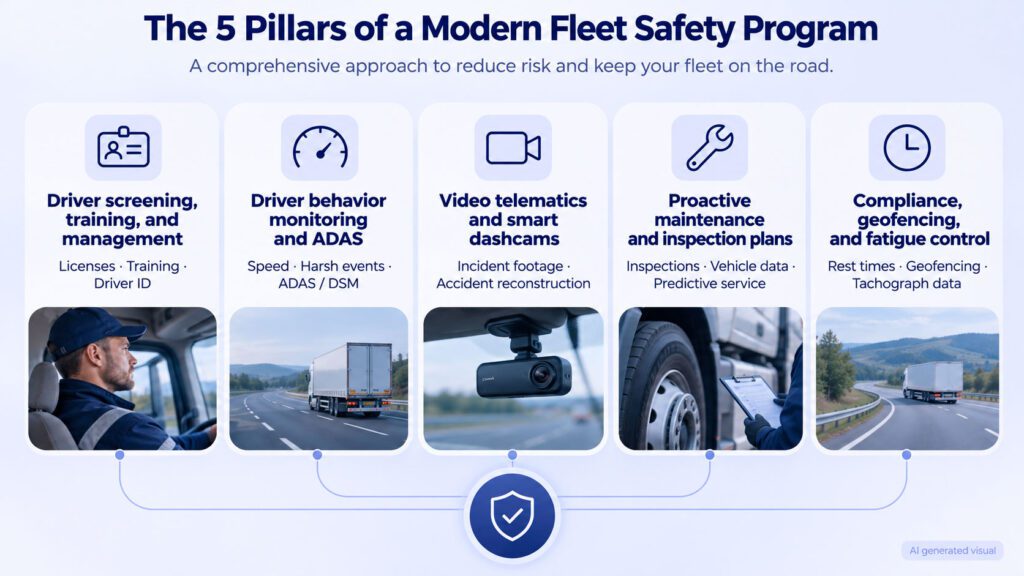
1. Driver Screening, Training, and Ongoing Management
Safety starts with the people you hire. Checking licenses and driving history, along with any background checks your industry requires, helps you bring in drivers who take the job seriously.
After that, keep skills sharp. Regular training in defensive driving, load securing, and fatigue awareness makes a real difference, especially when it’s based on each driver’s actual habits. A driver who brakes too hard needs different coaching from one who speeds on the highway, and generic courses rarely address either.
Technology can also make sure the right person is behind the wheel. Ruptela devices support driver identification with RFID cards, iButton keys, and BLE driver ID. Add an ignition-blocking relay, and the vehicle won’t start until an authorized driver identifies themselves. Every trip is then linked to a named driver, which makes it much easier to follow up on incidents.
2. Driver Behavior Monitoring and ADAS
Once a vehicle is on the road, driving style matters most. Telematics shows fleet managers how each vehicle is being driven, with data on speeding, harsh braking, sudden acceleration, and sharp cornering. A driver who regularly brakes hard often follows too closely or doesn’t look far enough ahead, and those habits are much easier to fix before they lead to a collision.
Some fleets also use Advanced Driver Assistance Systems (ADAS) and Driver Status Monitoring (DSM). ADAS relies on cameras and sensors to warn the driver about lane departures, short following distances or potential collisions. DSM focuses on the driver. It detects signs of fatigue or distraction, like yawning, closing eyes, or reaching for a phone, and sounds an alert in the cab. Many systems notify the fleet manager at the same time. Combined with behavior data, this gives a much clearer view of driver safety than speed reports alone.
3. Video Telematics and Smart Dashcams
Cameras have become a major trend in fleet safety, and it’s easy to see why. When an incident happens, a dashcam shows what really happened, often very different from what each party remembers.
That footage helps reconstruct accidents, speeds up insurance claims, and can clear a driver who wasn’t at fault. Many smart dashcams automatically save a snapshot or short clip when they detect a harsh event, such as sudden braking or an impact. Managers can go straight to the moments that matter instead of scrolling through hours of video.
Clips from your own fleet also work well for coaching. Drivers pay attention when the example comes from a road they know.
4. Proactive Maintenance and Inspection Plans
Even the best driver can’t do much if the brakes fail. That’s why pre-trip inspections are such a basic part of fleet safety. Before each shift, drivers should check tires, lights, brakes, mirrors, and fluid levels, and there should be a simple way to report anything that looks wrong.
Telematics makes this more reliable. Ruptela trackers read engine status, mileage, and engine hours from the vehicle’s CAN bus, and many models also work with tire pressure sensors. Instead of servicing vehicles on a fixed calendar, you can plan maintenance around actual usage, and alerts flag problems before a part fails on the road. That means fewer breakdowns and fewer vehicles stuck on the roadside.
5. Compliance, Geofencing, and Fatigue Control
Fatigue causes many serious road accidents, especially on long highway drives. A tired driver reacts more slowly, loses focus, and is more likely to misjudge a situation.
Start with realistic route planning, with enough time built in for breaks. Geofencing adds another layer. You can mark high-risk areas, such as accident-prone roads or unsafe parking spots, and get an alert when a vehicle enters one. For heavy vehicles, digital tachograph data shows how long each driver has been on the road and when their next mandatory break is due. With remote tachograph downloads on Ruptela’s HCV5 and HCV5 Lite, dispatchers can see this information without the vehicle returning to the depot, making it easier to ensure drivers actually rest.
How to Successfully Implement a Fleet Safety Policy
A policy only works if drivers buy into it. Here are a few things that help:
- Keep the rules clear. Write down what you expect on speed, phone use, rest breaks, inspections, and accident reporting in plain language.
- Ask drivers for input. They know where the real risks are on their routes, and people follow rules they helped create.
- Make it a bit of a game. Driver scorecards turn safe driving into friendly competition and let drivers track their own progress.
- Reward the best. Bonuses, awards, or simply thanking the safest drivers in front of the team all go a long way.
- Respect privacy. Explain what data you collect and why, and handle it in line with GDPR.
Good fleet safety management doesn’t stop once you write the policy. Check the results regularly and keep coaching drivers as your fleet grows and changes.
Secure Your Operations with Ruptela’s Safety Solutions
The right technology makes all of this much easier to manage. Ruptela’s fleet safety solution gives you the data you need to reduce day-to-day risk. Eco-Drive features show how each driver is doing and where they can improve. HCV5 and HCV5 Lite automatically download tachograph files, helping you stay on top of driving and rest-time rules. On supported devices, impact detection and accident reconstruction show what happened in an incident, and panic buttons let drivers send an instant alert in an emergency. Ruptela devices also connect to a wide range of sensors, from tire pressure monitoring to Thermo King reefer data.
Want to find out what would work for your fleet? Talk to our experts, and we’ll help you put together a telematics setup that fits your safety goals.