Tachograph Cards: A Complete Guide for Fleet Managers
Efficiently managing fleet compliance requires a deep understanding of the tools that track driver activity. Commercial transport in the European Union and AETR nations is primarily reliant on a specific hardware ecosystem and compliance processes. If a transportation company uses cars equipped with digital tachographs, understanding the specific laws regulating these systems is critical to preventing costly business interruptions.
What is a tachograph card?
Every commercial vehicle over 3.5 tons must use a digital tachograph to check compliance, making the digital tachograph card an essential part of everyday operations. A tachograph card essentially serves as a driver’s or transportation company’s legal identification in the eyes of regulatory organizations. The main purpose of this system is to promote road safety by preventing driver fatigue, ensuring fair competition among transport operators, and maintaining strict compliance with road transport regulations.
To maintain operational compliance and ensure drivers adhere to international labor laws, fleet operators must also stay fully updated on current regulations, which can be reviewed in detail in this comprehensive overview of tachograph rules.
The 4 Types of Tachograph Cards
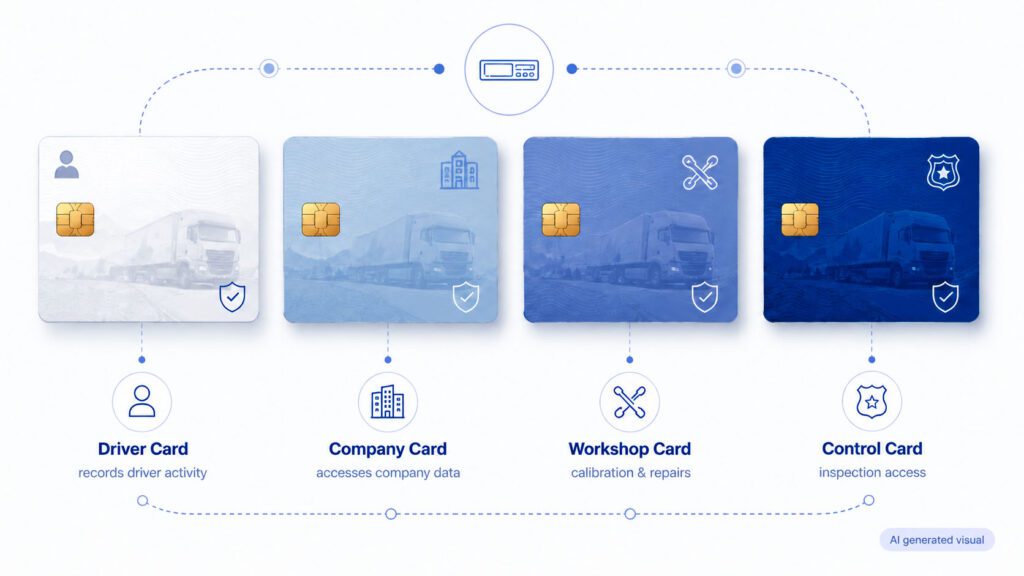
The compliance framework relies on a distinct ecosystem consisting of four specific types of tachograph cards. Each card serves a unique regulatory purpose, is color-coded for fast identification, and holds different levels of data access within the digital tachograph unit.
Driver Card (White)
The driver card is an individualized, personal card issued directly to the commercial driver. This specific digital tachograph card must be inserted into the tachograph unit whenever the driver is in control of a commercial vehicle. The tacho card logs personalized work histories, rest intervals, and vehicle operational data. Because it serves as a legal identity document, a driver may hold only one valid driver card at any given time.
Company Card (Yellow)
The company card belongs directly to the fleet owner or transport operator. It does not record any driving metrics itself. Instead, the company card allows fleet managers to lock operational data within the digital tachograph to protect company privacy from unauthorized third parties. It also acts as the physical security key required to access, display, and download mass memory data from the vehicle unit for compliance archiving.
Workshop Card (Red)
The workshop card is restricted exclusively to authorized technicians and approved calibration centers. This card allows certified mechanics to install, calibrate, test, and repair digital tachograph units. Unlike other variants, a workshop card is the only type of tacho card that permits a user to modify specific internal system parameters and calibration settings of the equipment.
Control Card (Blue)
The control card is used solely by law enforcement officers, road transport inspectors, and agencies like the DVSA. When inserted into a digital tachograph, the control card completely bypasses any company privacy locks. This allows inspectors to immediately read, print, or download driver card data and vehicle memory records during roadside checks to ensure compliance with transport laws.
How a Driver Card Works
Operating a digital tachograph requires absolute consistency from commercial operators. Before starting a daily shift, a driver must insert their personal driver card into slot one of the digital tachograph units. Once authenticated, the tacho card dynamically records real-time metrics including vehicle speed, total distance traveled, and specific activity states such as active driving, other work, periods of availability, and rest.
A standard digital tachograph card has a finite internal storage capacity. Generally, a driver card stores at least 28 days of detailed historical driving data. Once the tachograph card’s internal memory capacity is reached, the oldest data is automatically overwritten by new entries.
Driving a commercial vehicle without a valid driver’s card is a major regulatory violation and can result in severe operational penalties. The only exceptions apply if a card is physically lost, damaged, or stolen during a route. In these circumstances, drivers must immediately print the vehicle trip records at the start and end of their journey, sign the printout manually, and submit an application for a replacement tacho card within 7 days.
Data Download Deadlines: The 28 and 90-Day Rule
Ensuring data continuity is one of the most critical elements of road transport compliance. Transport regulations mandate strict time limits for extracting information from equipment to ensure files are archived before they are overwritten.
- Driver card download. Data must be retrieved from the individual driver card at least every 28 days. This is known across the transport industry as the 28-day rule tachograph requirement.
- Vehicle unit download. The mass memory from the internal digital tachograph unit inside the vehicle must be downloaded at least every 90 days.
These timelines represent the legal maximum limits, not recommended intervals. Manually managing these staggered download schedules across multiple vehicles and drivers creates a massive operational headache for modern fleet management teams. Missing a single deadline due to driver absence or scheduling oversights can leave a business exposed to significant regulatory audits and fines.
Managing DDD Files
When data is extracted from either a driver card or a digital tachograph, it is stored in a highly specific digital format known as DDD files. These electronic records are heavily encrypted to prevent tampering and must maintain complete cryptographic authenticity to be considered valid during an inspection.
Under strict European transport guidelines, a company must store these raw .ddd files securely for at least twelve months from the date of capture. However, simply storing the raw tachograph card data on a local drive is insufficient for complete compliance. Fleet management teams must actively decode and analyze these DDD files using dedicated compliance software. This analytical step ensures that no driver’s hours rules or mandatory rest period guidelines have been breached, allowing companies to address hidden behavioral issues before an official audit by an authority.
The Solution: Remote Tachograph Download
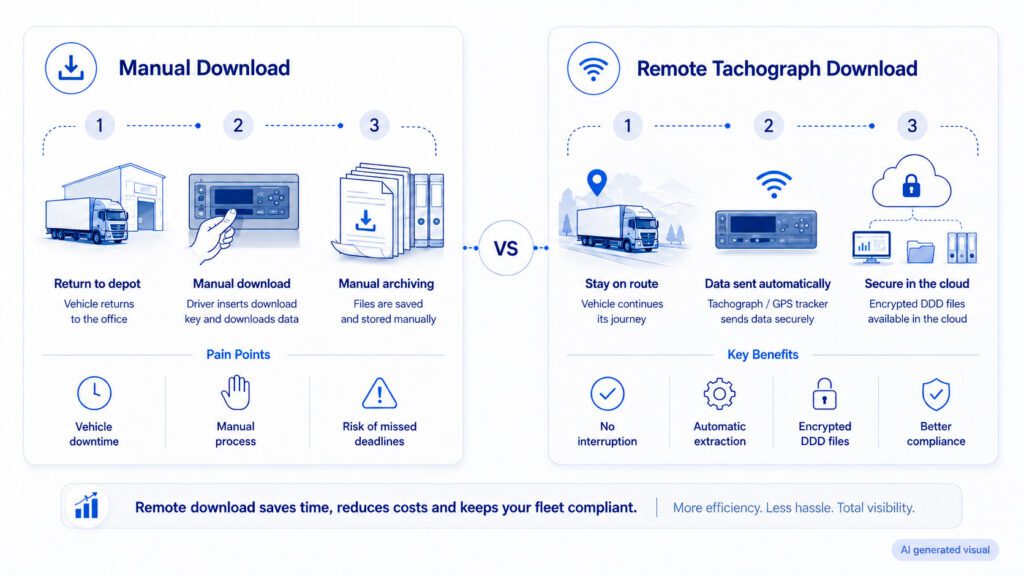
The traditional manual data retrieval method is highly inefficient for modern fleet operations. It requires a truck to be physically routed back to a main depot, forcing a fleet manager to manually connect a download key to the digital tachograph and copy the driver card data. This manual process consumes hours of administrative time, increases vehicle downtime, and complicates route planning.
| MANUAL DOWNLOAD PROCESS | |||||
| Truck Routes to Depot (High Downtime) | → | Manual Key Inserted (Time Consuming) | → | Files Archived (At Risk of Fines) | |
| vs | |||||
| REMOTE TACHOGRAPH DOWNLOAD | |||||
| Vehicle is En Route (Zero Interruption) | → | Automatic Wireless Extraction via GPS | → | Encrypted Files Sent to Office | |
Modern fleet management solves this logistical challenge through the implementation of a hardware-driven Remote Tachograph Download system. By integrating advanced telematics solutions, such as the Ruptela HCV5 series, transport operators can fully automate the data collection process without interrupting daily routes.
Implementing an automated remote downloading system provides immediate operational advantages:
- Automatic downloads. The telematics platform automatically schedules and wirelessly extracts data from the driver card and vehicle unit. There is no need to stop the truck or alter a driver’s schedule to return to a warehouse.
- Administrative time savings. Encrypted DDD files are sent directly to the central office network via an installed Ruptela GPS tracker, removing the need for manual administrative tasks.
- Elimination of compliance fines. The automated scheduler ensures that the 28-day rule tachograph deadlines and 90-day vehicle limits are met precisely, eliminating human error.
- Real-time operational visibility. Dispatchers gain instant visibility into a driver’s remaining driving time. This data helps fleet management plan upcoming schedules accurately, preventing accidental violations of driver fatigue regulations.
Consequences of Mismanaging Tachograph Cards
Failure to properly manage a fleet’s tachograph card download procedure exposes a transportation firm to serious legal and financial consequences.
Common consequences of poor data management include:
- Heavy financial fines. Graduated penalties for missing data or exceeding driving limits can quickly add up to thousands of euros per individual infraction.
- Loss of transport operating licenses. Repeated failures to provide valid, uncorrupted DDD files upon request can result in authorities suspending or permanently revoking a company’s operating credentials.
- Degraded safety ratings. Compliance violations are publicly tracked in enforcement databases, leading to poor corporate safety scores, frequent roadside inspections, and higher commercial insurance premiums.
Conclusion: Digitizing Compliance
While operating a compliant transport business requires strict adherence to digital tachograph rules, managing the resulting data need not be a manual, labor-intensive burden. Moving away from manual downloads protects a business from unexpected compliance gaps.
By implementing professional fleet management software and automated hardware tools, transport companies can transform a complex legal requirement into a seamless background workflow. To safeguard operations and protect profit margins, consider integrating advanced fleet automation tools, such as the Ruptela HCV5, to keep your vehicles moving productively.
FAQ
Who is exempt from using a tachograph?
Exemptions generally apply to non-commercial vehicles under 7.5 tonnes, vehicles with a maximum authorized speed under 40 km/h, emergency service vehicles, and vehicles driving within a 100 km radius of their base for agricultural or non-commercial purposes.
Can I drive a 7.5t vehicle without a tachograph?
No, you cannot drive a 7.5-tonne vehicle for commercial transport without a functional digital tachograph unit installed and active, unless the vehicle falls under a highly specific non-commercial or public service exemption.
Can I drive a lorry without a digital tachograph card?
Driving a commercial lorry without an active driver card is illegal. The only exception is if your tachograph card is lost, stolen, or damaged while on a route, in which case you must generate manual daily printouts while awaiting a replacement.
What is the 10-hour rule for the tachograph?
The rule dictates that a driver’s standard daily driving limit is 9 hours. However, this limit can be increased to a maximum of 10 hours up to two times within a single fixed week.
Can I check my tachograph card online?
Drivers cannot directly check their tachograph card online through a standard browser. Viewing internal data requires either physically reading the chip with a dedicated smartphone app and an NFC reader or downloading the files through fleet management software.
How much does a tachograph card cost?
The application fee varies by country and jurisdiction. For example, in the UK, a first-time applicant learning how to apply for a tacho card through the DVLA will pay a standard fee of £32. At the same time, regional costs across the EU typically range between €30 and €80, depending on local issuing authority guidelines.