CAN For ALL: Access More Vehicle Data Without Replacing Your Hardware
Vehicle technology is developing quickly, but replacing an entire telematics installation every time a new data interface appears is rarely practical. Fleets may already have reliable tracking devices in place, while newer vehicles increasingly use CAN FD alongside established CAN 2.0 networks. Other projects rely on basic trackers without a physical CAN input, and complex commercial-vehicle setups may need data from several sources at the same time.
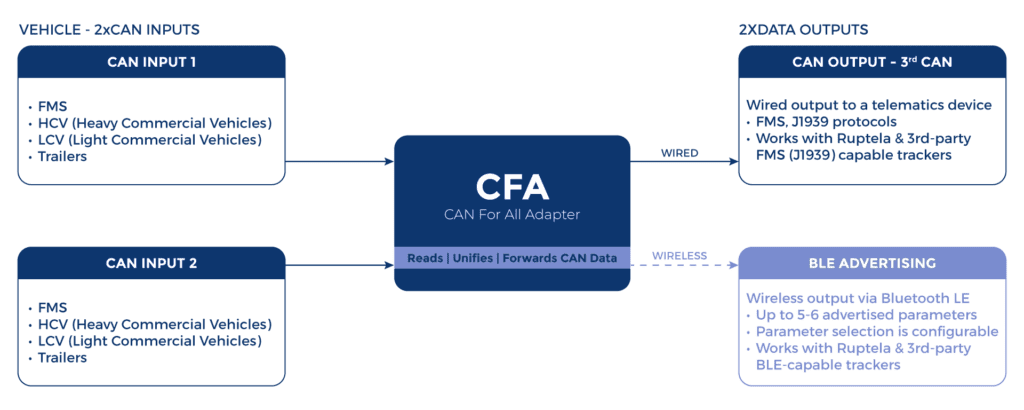
Ruptela CAN For ALL (CFA) is designed to bridge these gaps. It is a compact, universal adapter that reads vehicle data from up to two CAN interfaces, processes it into a unified format, and forwards it to an existing telematics device. The result is easier access to vehicle data without replacing the already installed GPS tracking device.
What is CAN For ALL?
CAN For ALL extends the CAN capabilities of an existing telematics setup. Its two CAN FD-capable inputs can collect data from CAN 2.0 or CAN FD networks in heavy commercial vehicles, light commercial vehicles, and trailers. The adapter then delivers the processed data through one of two outputs:
- Wired CAN output. Data is sent through a third CAN interface using standardized J1939/FMS communication, with support for truck and trailer data and Ruptela-specific parameters for light commercial vehicles.
- Wireless Bluetooth LE output. Selected parameters are broadcast to a nearby tracker or BLE gateway, including devices that do not have a physical CAN input.
Why fleets and telematics providers need CAN For ALL
A mixed fleet can include older and newer passenger cars, vans, trucks, and trailers, often equipped with tracking hardware from different generations or vendors. Available vehicle data, connector types, and tracker interfaces can vary significantly. CFA creates a practical connection layer between these systems.
Instead of treating every new vehicle or CAN FD integration as a complete hardware migration, providers can retain the existing tracker and add access to the data required for the project. Standardized output also helps create a more consistent data flow across a diverse fleet, while the compact form factor simplifies installation in limited spaces.
CAN For ALL in Practice
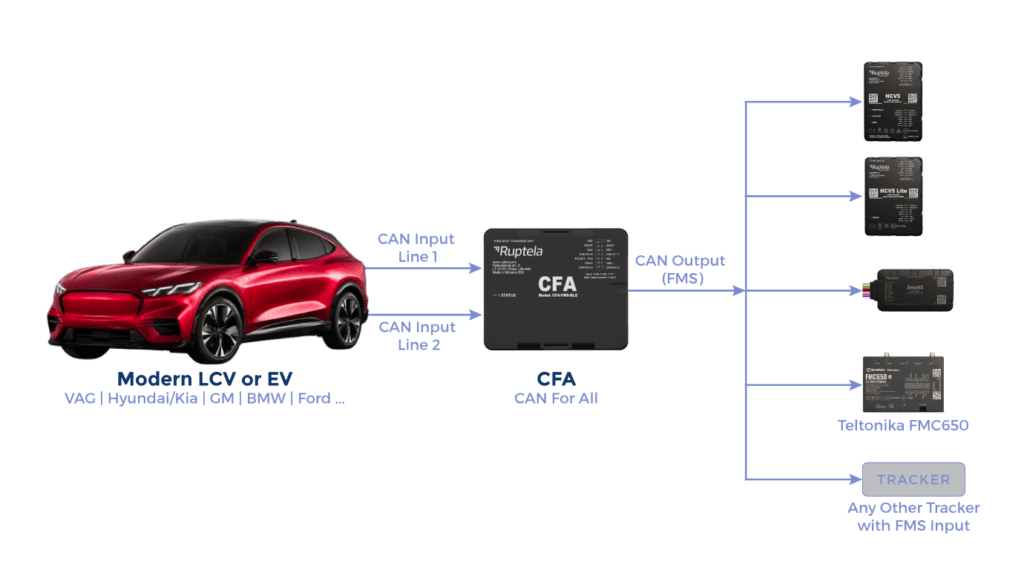
Access CAN 2.0 and CAN FD Data from Modern Vehicles
Modern light commercial vehicles and electric vehicles increasingly use CAN FD alongside established CAN 2.0 networks. Existing trackers may continue to provide reliable positioning and connectivity but lack the interface required to read data from these newer vehicle systems.
In this setup, CFA collects data from up to two CAN 2.0 or CAN FD lines, decodes it, and delivers it through a wired CAN output in FMS format. The connected tracker receives the processed data through its CAN input, extending access to modern vehicle information without requiring a complete hardware replacement.
The setup can be used with Ruptela HCV5 and HCV5 Lite, Teltonika FMC650, or another compatible tracker with an FMS input. It supports modern LCV and EV platforms from manufacturers such as Volkswagen Group, Hyundai and Kia, General Motors, BMW, and Ford. Available parameters depend on the vehicle model, network architecture, and integration.
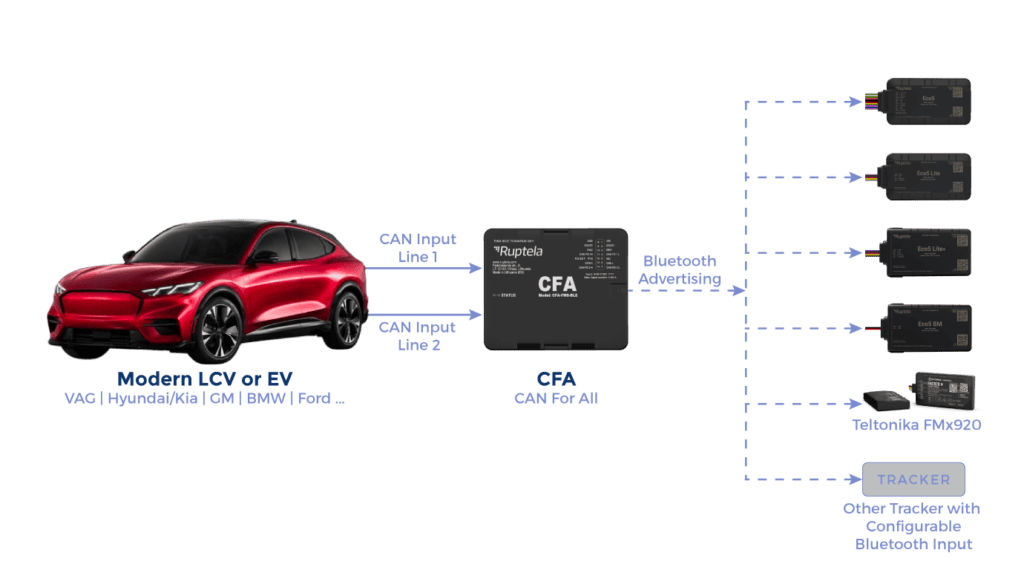
Add CAN data to BLE-Only Trackers
Some tracking devices provide essential positioning and connectivity but do not have a physical CAN port. CFA adds vehicle data access by collecting and processing CAN information, then broadcasting selected parameters via Bluetooth LE. Compatible devices include the Ruptela Eco5 family, Teltonika trackers with configurable Bluetooth input, and other trackers capable of reading BLE advertisements.
This allows telematics providers to extend existing installations without replacing functional tracking hardware or being limited to one manufacturer. Because Bluetooth advertising frames have limited capacity, up to six selected parameters can be broadcast, depending on their size.
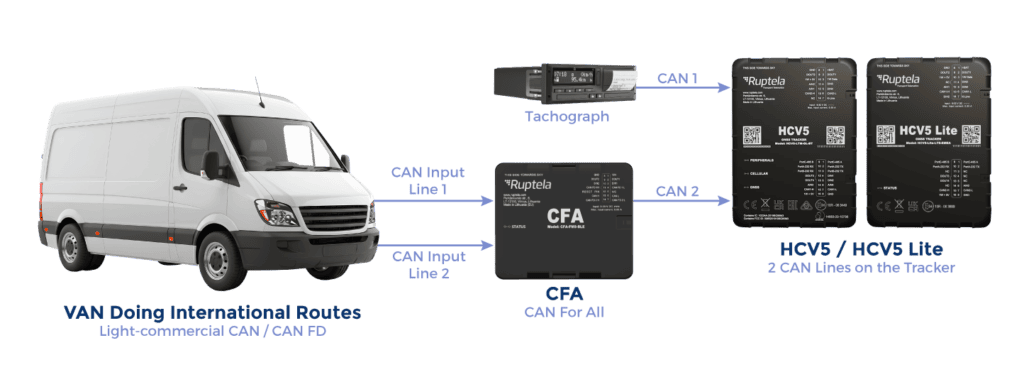
Combine Tachograph and Van Data
From 1 July 2026, light commercial vehicles weighing between 2.5 and 3.5 tonnes and used for international transport or cabotage must be equipped with a Smart Tachograph Version 2. This means fleet operators need to manage tachograph information alongside operational vehicle data, which can create an integration challenge when multiple data sources must be handled simultaneously.
CFA simplifies this setup by collecting data from the van’s CAN network and delivering it to an HCV5 or HVC5 Lite device. The tracker can then receive both vehicle and tachograph data, bringing compliance-related information and day-to-day fleet insights together in one telematics setup.
Combine Tachograph, Truck and Trailer Data
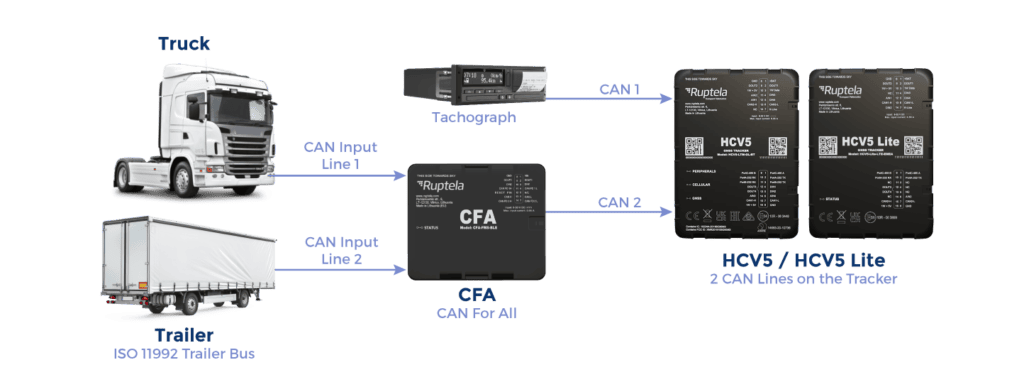
Truck-and-trailer operations may require data from three separate sources: the truck’s CAN network, the trailer’s CAN network, and the digital tachograph. CFA collects and combines the truck and trailer CAN data, then delivers it to an HCV5 or HCV5 Lite device through a single output. The tracker also receives tachograph information, bringing all three data sources together in one telematics solution.
Access More Data with Your Existing Setup
From modern vehicle data reading to complex tachograph integrations, CAN For ALL expands the capabilities of existing telematics hardware across a wide range of use cases.
Ready to explore what CFA can bring to your setup? CAN For ALL is scheduled for release in summer 2026. Contact your Ruptela Sales Manager to learn more.