The Next Wave of Compliance: Smart Tacho 2 Becomes Mandatory for Vans in Cross-Border Logistics
As part of the ongoing rollout of the EU Mobility Package, a major deadline is fast approaching. Starting July 1, 2026, the mandatory adoption of the Smart Tachograph Version 2 (G2V2) will extend to light commercial vehicles (LCVs) weighing between 2.5 and 3.5 tonnes engaged in cross-border transport or cabotage.
If your business operates international delivery vans, express couriers, or light freight transport across European borders, the rules of the game are changing.
Why is the EU Extending the Rules to LCVs?
The development of e-commerce and fast-moving international logistics has transformed the light commercial vehicle market. Large vans, such as those used by global courier networks and express delivery services, are increasingly transporting freight across borders on routes previously handled only by heavy commercial vehicles (HCVs).
Because these two vehicle segments frequently operate in the same market, the European Union is seeking to level the playing field. The extension of the Smart Tacho 2 mandate aims to achieve three primary goals:
- Enhance road safety. Ensuring van drivers are bound by the same fatigue-preventing rest rules as truck drivers.
- Fair competition. Preventing operators from undercutting transport costs by overworking drivers in unregulated light fleets.
- Streamlined enforcement. Giving authorities the technological tools to easily monitor cabotage operations and legal driver postings.
Who Needs to Act? Industries Most Affected by the Smart Tacho 2 Mandate
Most operators in these segments have never had a tachograph before. The ones who act early avoid fines, delays, and rushed last-minute installations.
Courier & parcel – highest urgency. Daily cross-border routes in Benelux, DACH, and FR–ES corridors. Owner-operator delivery service partners and express networks are scrambling to comply. This is the biggest segment by number of vehicles. Examples: DHL Express, DPD, GLS, Amazon DSPs.
E-commerce fulfillment – very high urgency. Explosive van fleet growth driven by online retail. Gig-economy delivery partners have zero compliance infrastructure today. Examples: Amazon DSPs, Zalando Logistics, Temu hubs.
Refrigerated food & pharma – high urgency. Temperature-controlled vans crossing borders daily. Time pressure combined with legal driving hour limits creates an urgent monitoring need. Examples: Frigo Logistics, restaurant supply chains, grocery carriers.
Construction & trades – high urgency, mostly unaware.Thousands of contractors crossing into Luxembourg, Switzerland, and Nordic borders daily. Largely self-employed with zero awareness of the regulation. The first to be educated will be the first to comply. Examples: HVAC, electrical, plumbing, and scaffolding SMEs.
Automotive parts (just-in-time) – critical operations risk. Van shuttles on routes like Cologne→Liège→Ghent carrying just-in-time parts. One roadside prohibition stops an assembly line. Compliance here is an operational argument, not just a legal one. Examples: Geis Automotive, OEM dealer networks, Dachser Auto.
Artisan food, wine & craft – totally unaware, easy win. Wine estates, breweries, and specialty food producers delivering to restaurants cross-border. The smallest compliance gap and the easiest route in via distributor channels. Examples: wine estates, craft breweries, specialty food producers.
The July 1, 2026 Mandate: Who is In Scope?
The upcoming regulation is strictly defined by three conditions. Your fleet will fall under the Smart Tacho 2 mandate if your The upcoming regulation is strictly defined by three conditions. Your fleet will fall under the Smart Tacho 2 mandate if your vehicles meet all of the following criteria:
- Vehicle mass. The maximum authorized mass of the vehicle (including any trailers or semi-trailers) is between 2.5 and 3.5 tonnes.
- Activity character. The transport is carried out for hire or reward (commercial freight transport).
- Geographic scope. The vehicle crosses international EU borders or engages in cabotage operations (deliveries within an EU Member State other than the one where your business is established).
Note: Purely domestic transport and certain “own-account” operations (such as a technician carrying their own tools where driving accounts for less than 30% of their monthly working time) may qualify for exemptions.

When Is a Tachograph Required?
Understanding the rules in practice matters as much as knowing the legal criteria. From 1 July 2026, the following situations trigger the legal requirement to operate a Smart Tachograph Version 2:
- Cross-border delivery vans. Any van crossing an EU border to deliver goods for a paying customer is in scope – it doesn’t matter which country or which border.
- Driving back empty. If the van is empty on the return leg, it’s still part of a commercial transport job. “We had no goods on board” won’t hold up at a roadside check. Inspectors assess the operation as a whole, not individual trips.
- Doing local jobs in another country. Picking up and dropping off goods within a country your business is not based in – for example, collecting a local load while already in Germany – counts as cabotage and triggers the requirement.
- Vans used for goods only sometimes. If a van is occasionally used for commercial deliveries alongside other uses, it’s in scope for those trips. Each vehicle must be assessed individually – don’t assume mixed-use vehicles are exempt.
When is a Tachograph NOT Required?
Not every van in this weight range needs a tachograph. The following situations are exempt:
- Staying within one country. If the van never crosses a border, no EU country currently requires a tachograph for this size vehicle. The border crossing is what triggers the requirement.
- Service vans (your tools, your jobs). If the van carries only your own tools or equipment, you are not charging for the transport itself, and driving accounts for less than 30% of the driver’s monthly working time – all three conditions must apply simultaneously.
- Farming, forestry & utilities. Agricultural and forestry vans within approximately 100 km of base. Emergency services and utility crews (gas, water,electricity) also exempt, though rules vary by country.
- Emergency and public services. Police, fire, ambulance, armed forces, and specialist utility vehicles are fully exempt. This is defined by the type of organisation, not the route or destination.
- Electric and alt-fuel vans. EVs and alternative fuel vans benefit from a higher weight threshold – 4.25 tonnes instead of 3.5 tonnes. If your electric van is under 4.25t, it falls outside the scope of the regulation entirely.
- Fixed short passenger routes under 50 km. Vans shuttling passengers on fixed, regular scheduled routes under 50 km are exempt. This does not apply to one-off or flexible trips, only regular scheduled routes qualify.
The Service Van Exemption
This exemption is real, but it is not automatic. All three conditions must be true at the same time, and you need proof ready.
1. You’re carrying your own stuff.
The van carries your company’s own tools or equipment – not goods you are being paid to transport. The moment a customer is paying for the transport, this condition fails.
✓ Technician driving to a job site with their own tools
✗ Van delivering goods or parcels on a customer’s behalf
2. You’re not charging for the transport.
The trip itself is not a paid service. You are driving somewhere to do a job – the transport is just how you get there, not what you are selling.
✓ Field engineer driving to install equipment at a client site
✗ Any company billing customers a separate line for delivery
3. Driving isn’t the driver’s main job.
The driver must spend most of their time doing something other than driving. As a guide, driving should account for under 30% of monthly hours – but inspectors look at the full picture, not just the number.
✓ Engineer who drives 2 hours and spends 6 hours on site doing repairs
✗ Someone whose primary role is operating the vehicle
All three conditions must apply simultaneously. Inspectors will not assume your vans are exempt. If you cannot clearly show all three conditions are met, the default assumption is that a tachograph is required. Keep job descriptions, time records, and transport documents ready at all times.
What Makes Smart Tacho Version 2 Different?
The required hardware is not a standard digital tachograph. It must be a second-generation smart tachograph (G2V2). These aThe required hardware is not a standard digital tachograph. It must be a second-generation smart tachograph (G2V2). These advanced units are designed to capture data with high security and minimal driver intervention, using the European satellite navigation system (Galileo).
Key features of the Smart Tacho 2 include:
- Automated border crossing tracking. The device automatically logs the exact time and location whenever a vehicle crosses a border, removing the need for manual entries.
- Loading and unloading logs. Drivers can flag exactly when and where freight is loaded or unloaded, helping track cabotage limits.
- Remote data enforcement. Built-in Dedicated Short-Range Communication (DSRC) technology allows enforcement officers to read tachograph data remotely from the roadside. If your data is fully compliant, you can keep driving without being flagged down, preventing delivery delays.
Along with the hardware, drivers will now need to manage official driving and rest limits, including a maximum of 9 daily driving hours and a mandatory 45-minute break after every 4.5 hours of cumulative driving.

Driver Hours Rules That Now Apply to Van Drivers
Starting July 1, 2026, van drivers in scope must comply with the same EU driving time rules as HGV drivers. These are not suggestions, but they are legally enforceable limits.
Driving limit requirements:
- Daily driving – maximum 9 hours (10 hours allowed twice per week)
- Weekly driving – maximum 56 hours
- Fortnightly driving – maximum 90 hours over any two consecutive weeks
- Continuous driving – maximum 4 hours 30 minutes before a mandatory 45-minute break
- Daily rest – minimum 11 hours between working days
Data management requirements:
- Driver card download – must be downloaded at least every 28 days
- Vehicle unit download – must be downloaded at least every 90 days
- Data retention – records must be stored for at least 12 months and available for inspection
What Happens If You Don’t Comply?
Fines for operating without a Smart Tachograph 2 are set nationally and vary significantly across EU member states. On top of financial penalties, non-compliant vans can be held at the roadside until a compliant device is fitted, which means missed deliveries, broken SLAs, and potential penalty clauses from customers. One non-compliant driver can accumulate €2,000+ per month in fines across multiple stops – before you add the cost of a van being held at the roadside.
Preparing Your Fleet: Remote Tachograph Solutions
Retrofitting a light commercial vehicle fleet requires careful planning. Unlike heavy-duty trucks, many vans were not originally designed with a dedicated dashboard slot for a tachograph, making early hardware integration vital to avoid workshop bottlenecks as the deadline approaches.
To maintain complete compliance while increasing operating efficiency, fleet managers want a telemetry configuration that goes beyond simply hosting the physical tachograph. Automating data management saves administrative time and protects your company from expensive compliance blunders. Advanced tracking devices are particularly designed to provide smooth, remote tachograph administration.
How the Ruptela solution works:
- Smart Tachograph V2 (fitted by approved workshop) – records driving time, speed, GPS position, and driver identity. Legal compliance starts here.
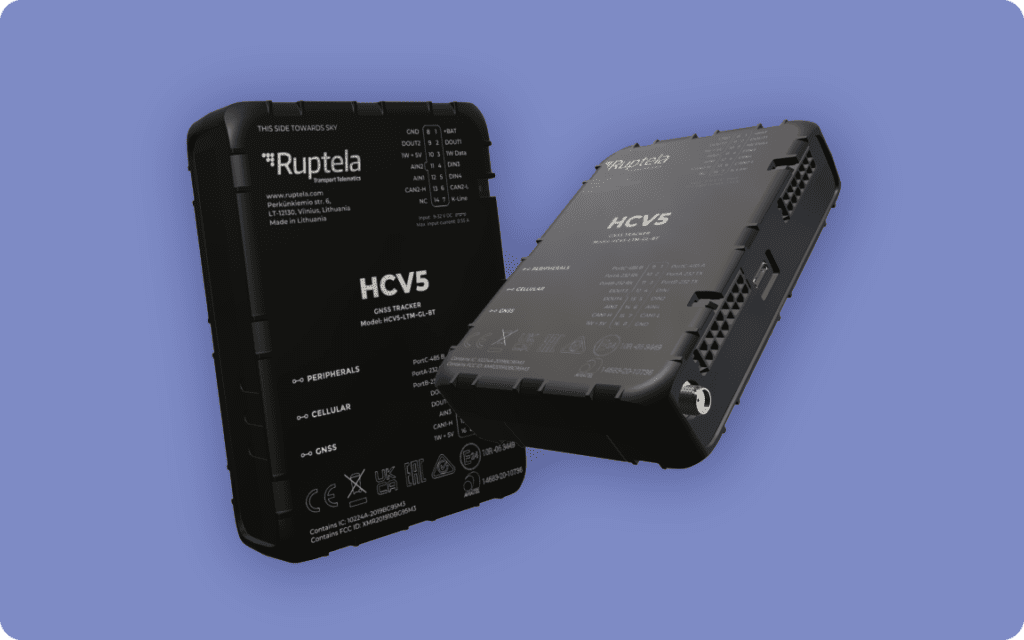
- Ruptela tracking device (HCV5 / HCV5-Lite) – reads tachograph data via ITS interface and CAN bus, transmits everything to the cloud over 4G/LTE. Reads the data, adds GPS, sends everything to the cloud.
- Cellular network – 4G/LTE encrypted transmission, real-time and scheduled.
- TrustTrack platform – compliance dashboard, driver hours reports, download deadline reminders, live fleet map, and 12-month tachograph archive. Makes the data visible, actionable, and audit-ready. Built for universality, Ruptela hardware also integrates seamlessly with many major third-party software platforms
1. HCV5
The HCV5 is a premium, full-featured fleet management tracking device designed for complex operations. It connects directly to the vehicle’s tachograph interface, allowing fleet managers to download tachograph files (.ddd format) and driver card data completely over-the-air (OTA). It eliminates the logistical challenge of manually pulling data from every single delivery van every month, ensuring your records are securely archived for the legally required 12-month period.
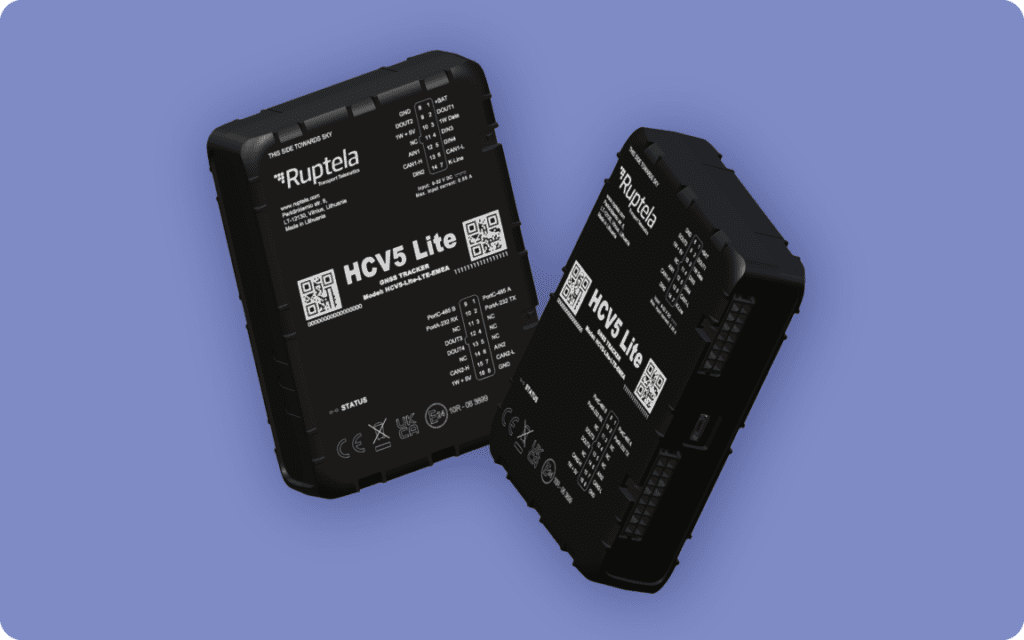
2. HCV5-Lite
For businesses looking for a highly efficient, compact compliance solution, the HCV5-Lite delivers advanced tachograph connectivity in a streamlined hardware footprint. It provides the same dependable remote download capabilities and real-time tracking features, making it an ideal choice for light commercial vehicle fleets looking to secure compliance ahead of the July deadline without adding unnecessary hardware complexity.
By integrating these devices with comprehensive fleet management software, you can track remaining driving time in real time, predict necessary rest stops, and easily handle data downloads within the required legal cycles (every 28 days for driver cards; every 90 days for vehicle data).
Action Checklist for Fleet Managers: Preparing for Smart Tacho 2
To ensure a transition before the rules take effect, consider taking the following operational steps today:
- Audit your fleet. Identify every vehicle in your fleet between 2.5 and 3.5 tonnes that handles cross-border assignments.
- Check for exemptions. For service vans, go through the three conditions honestly. If they apply, document it: job roles, time records, and transport paperwork.
- Secure hardware and workshop dates. Book installations for your Smart Tacho 2 hardware and tracking units early, as certified workshops face high demand.
- Order driver cards. Ensure all international van drivers apply for their official digital tachograph cards via national transport authorities.
- Train your staff. Educate your driving personnel on how to properly operate the tachograph, manage manual work entries, and adhere to legal rest periods.
The expansion of the EU tachograph regulations marks a new era of professionalism and safety for the light commercial vehicle sector. Embracing Smart Tacho 2 early keeps your fleet compliant, protects your drivers, and ensures your cross-border supply chains run smoothly without interruption.